
NEWS & VIEWS

Does it bring a ‘laser like focus to delivery’?
Thoughts on draft NPPF Chapter 20 Historic Environment.
With the consultation on the redrafting of the NPPF issued just before last Christmas the government stated its aims for the redraft was to tackle the country’s housing crisis and to support growth all by speeding up the planning process and decision making by ‘bringing a laser like focus to delivery’ by providing better clarity. But does this rewrite of the historic environment chapter help to achieve those goals?
Plan-making policies
As with other parts of the NPPF, the historic environment chapter is now clearly divided between plan-making policies and decision-making policies which is welcome amendment. Of particular note under HE1(d) local plans should ‘be supported by a local list to identify non-designated heritage assets…’
This is broadly welcomed as hopefully this will assist in bringing clarity to where and what is a non-designated heritage asset (NDHA). This in turn will hopefully assist with the later decision-making policy on NDHA (HE7).
However, how many local authorities have an up-to-date local list or a list at all? My feeling is that the already stretched conservation services will struggle to fulfil this requirement and funding will need to come forward to get this resolved. Another issue, and sadly one from past experience, is that it will be important to ensure the integrity of how and what buildings are included on the list, and the local list is not used to try and block development which is already entered the planning process.
Just ‘Harm’ and Substantial Harm defined
Most commentary on Chapter 20 has been on the shortening of the term ‘less than substantial harm’ to just ‘harm’. This is a simplification of terminology than anything else and one that has been pushed for in consultee quarters for some time. But the biggest change is at HE5 (2c) with the inclusion of a definition of substantial harm which is set out as occurring ‘where the development proposal would seriously affect a key element of the asset’s significance’.
The result of this definition is that it lowers the bar to substantial harm from that previously defined in case law as being where the significance of a heritage asset is ‘very much, if not all, of the significance was drained away…. that its significance was either vitiated altogether or very much reduced’. This resulted in making substantial harm a very high test indeed. So now the test for substantial harm comes back to what are the key elements of an asset’s significance, and notably just a single element of significance needs to be affected (to a serious extent) to cause substantial harm.
As the NPPF Glossary currently stands, the definition of an asset’s significance is derived from its heritage interests, whether archaeological, architectural, artistic or historic. Presumably the heritage interests stated here are the ‘elements’ that are stated in the policy. However as the NPPF Glossary states ‘Significance derives not only from a heritage asset’s physical presence, but also from its setting.’
So setting is a key element of an asset’s significance as well? I think so. Does this mean will we start to see much more assessments of substantial harm to an asset due to development in its setting when previously this would have been ‘less than substantial’ harm? Will this potentially mean we will start to see new development not being permitted?
Positive effects but what about to preserve?
Following on from the previous point, the degree of harm must still be required to be expressed as a scale of harm and we will have to await what any supporting planning guidance says about this.
At HE6 (1) the potential effects on designated heritage are listed as being either ‘positive, harm, substantial harm or total loss’. What has happened to neutral effect, no effect or to preserve? In the push to emphasise positive effects of development on the historic environment the legal desire to preserve seems to have dropped out. I think HE6 (2) should include provision for development proposals to be approved which preserve (no effect/ no harm) an asset and not only those that have a positive effect. This would ensure consistency with HE5 (2) and to link the NPPF back to the primary legislation of the Planning (Listed Building and Conservation Areas) Act (1990), and hopefully speeding up the planning process.
Public Benefits versus Harm
Important public benefits are now listed out at HE6 (3) which can be weighted against harm to designated heritage assets. These include securing the long-term re-use of a vacant or underused listed building, and enabling energy efficiency and low carbon heating measures to be employed. The need for ‘optimum viable use’ at paragraph 216 has been dropped and this may help to see the re-use of currently unloved designated heritage assets brought forward which is welcomed. In contrast, substantial harm may be harder to justify as in the list of requirements under HE6 (4) for this higher test now proposes that no ‘suitable’ (rather than viable) use for the heritage asset found in the medium term through marketing that would enable its conservation can be found. However I would be recommending to my clients to avoid substantial harm or total loss to a designated heritage asset, but it is interesting to see the fallback position being stated.
Arbitration of Heritage Assessments
Clause 4 of HE5 requires ‘Decision makers should be satisfied that this assessment accurately reflects the effects on heritage assets caused by the proposals.’ It is noted that no other discipline within the NPPF requires this sort of arbitration of assessment. This clause does nothing to advance the aim of, or adding any value to, streamlining the planning process.
This could clearly prove problematic where a robust and proportionate Heritage Impact Assessment reaches conclusions that differ from an officer’s judgement. Will we end up in a situation where the heritage consultant and conservation officer both agree there is harm but at different scales resulting in a heritage impact assessment not fulfilling HE5 requirement? If so, I feel this clause will only end up in more planning delays as yet more decisions end up at planning appeal.
Non-designated Heritage Assets
The perennial problem of non-designated heritage assets (NDHA) within the planning regime appears to remain and may even get worse. At first glance this appears to be a slight reworking of paragraph 216. The subtle changes to wording which could have big effects on planning success and has elevated the importance of NDHA with the policy test now comparable to the assessment involving designated heritage assets.
Previously the effect on NDHA was simply to be taken into account within the wider planning balance. The revised policy now requires harm to non-designated assets to be outweighed by the benefits of the proposal. Notably, this refers to “benefits”, rather than “public benefits”, although in practice the distinction may be limited. This now introduces a standalone balancing exercise test. There is a risk this could influence the outcome of planning applications where NDHA are within sites and are wished to be demolished.
This issue comes back to the first point raised about local lists and the often lack of certainty of where, what and how something becomes a NDHA. Frustratingly for developers and planners they first appear on a site during the planning process or something is suddenly claimed to have historic interest but is not justified as to why to has enough historic interest to be considered a NDHA, which adds extra time and cost to a project.
Archaeological Assets
The draft NPPF now includes a section on archaeological remains (HE10). This appears to cement the need for archaeological investigation to identify (inform?) the design of development proposals, amongst other things, implying that this will become more part of upfront costs for developments that are not guaranteed.
The policy continues that archaeological assets should be preserved in situ wherever feasible. The presence of an archaeological asset shouldn’t necessarily require the need for preservation and its protection on site and a requirement such as this must be related to its actual significance; just as PPG16 used to set out all those years ago, the presumption should be to preserve in situ ‘nationally important archaeology’ not everything.
Final thoughts
The draft NPPF tries to present itself as trying to be positive for development, with emphasis on positive benefits and positive effects which are encouraged to be approved, along with the re-use of existing buildings. From a pure heritage perspective that might be laudable, but it seems to potentially make it more difficult for new development to come forward. The drive and emphasis is on the re-use of existing buildings over new construction, which will require more justification. Also the time and expense arguing over NDHA is only going to get worse in the absence of clearer definitions and without the support for local lists.
Whilst trying to shoot for the goal of laser like delivery this redraft may end up being more of an own goal. HAPRO Ltd will look with interest to the final version of the revised NPPF and will provide further comment over the coming months.
9 March 2026

Getting Plastered in Lutterworth
Background
As part of a recent planning application HAPRO Ltd helped to secure planning permission for the redevelopment of a brownfield site in Lutterworth, Leicestershire on behalf of Barcroft Estates. Unexpectedly during the planning determination period, the archaeological consultee for the planning authority requested archaeological and built heritage assessments, suggesting the site had archaeological potential due to it being near to a postulated course of a Roman Road and little information was known about the former factory on the site.
Nearby, on the opposite side of the road, is the site of the famous Vedonis Works where Sir Frank Whittle, during World War II, developed the jet-propulsion engine.
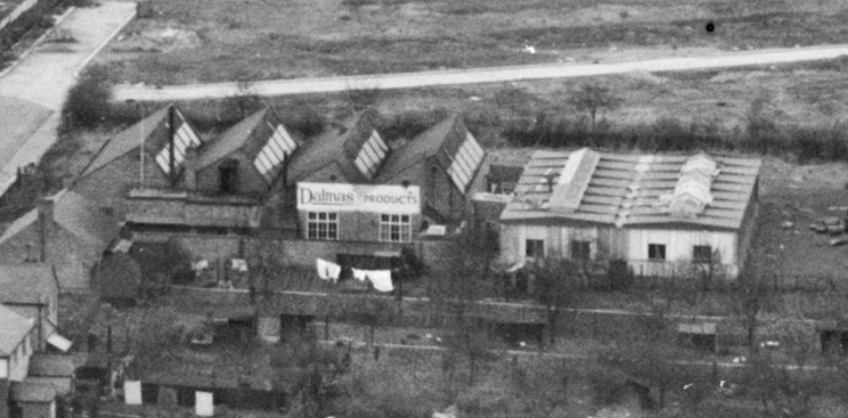
From historic Ordnance Survey maps the factory was constructed sometime between 1904 and 1956 but not much else was known. Fortunately the factory appears in the corner of an early aerial photograph from 1927, helping to place it into the first quarter of the 20th Century. It appears again in an 1946 aerial photograph , which showed it had expanded and a sign is visible on the side of the building which read ‘Dalmas Products’.
Dalmas Products
A De St Dalmas & Co of Leicester was established in 1823 as a manufacturing chemist. The Leicester based company specialised in medical plasters and fabrics, which included pioneering the production of waterproof plasters and Plaster of Paris bandages that were trademarked as ‘The Leicester’.
The company was incorporated in 1919 to acquire and carry on a business of manufacturing chemists, plaster makers and druggists sundries. The main factory was on Junior Street, Leicester. In 1932 Alfred Francis Emeric de St. Dalmas died and at some point after the company was renamed as Dalmas.
An 1951 newspaper advert for a range of Dalmas products notes main factories and laboratories were in Leicester and Lutterworth with branches in London, Leeds, Glasgow and Belfast. In January 1959 Dalmas Ltd became part of Belfast-based Cyril Lord group of companies. Lord was a British entrepreneur, known principally for the manufacture of carpets during the 1960s
The Leicester Evening Mail of 14 September 1960 records that N. Corah (another Leicester company with a long history in hosiery manufacture) bought Dalmas’ Junior Street factory and Dalmas Ltd were to extend their Lutterworth factory and open a new factory in Chorley, which reflects Cyril Lord’s Lancashire textile mill roots. The article notes that ‘to house the machinery from the Junior Street works an extension is to be built and the factory re-organised at Lutterworth.’
On 08 November 1963 the Leicester Daily Mercury records that there were 100 employees at the Lutterworth works, which converted cloth into commercial tape and surgical tape.
In 1965 the company moved to the new factory in Chorley where it focussed on making self-adhesive decorative plastics, signalling the decline of the Lutterworth site. However, by the end of 1969 the Cyril Lord group of companies collapsed. In 1982 the company name Dalmas was owned by British Insulated Callender’s Cables (BICC) but was not trading.
Back at the Lutterworth factory, from the 1980s onwards the building on the Site was occupied by a company that would become Medalin, a specialist medical hosiery and prosthetics manufacturer.
Outcome
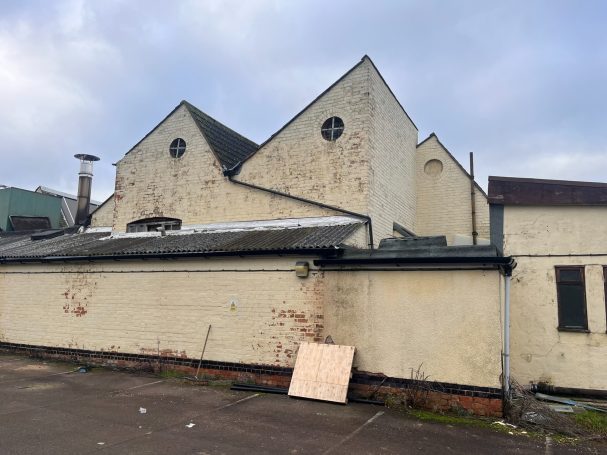
By studying the layout and materials of the building it was possible to distinguish at least six phases of the Lutterworth factory which could be related to the aerial photographs, historic maps and newspaper articles. Although the earliest phases of the building could be still interpreted in the standing fabric, the works were heavily modified from the 1960s onwards and there are no specific early fixtures or fittings that elucidate the original function of the building.
As for the below ground, recent archaeological work on the redevelopment of the Vedonis factory demonstrated that it is highly likely that any earlier remains would not have survived in the footprint of the building. Therefore the archaeological potential was negligible.
In light of this research the archaeological consultee for the borough agreed there was no need for further archaeological work and was satisfied with the research into the building so that there was no historic environment objection to the proposed development.
Our proportionate, prompt and professional approach ensured that there was no delay to the determination period and the application could go to planning committee as intended. The planning committee voted unanimously in favour of the development.
Images: © Historic England © Grace's Guide © HAPRO Ltd
26 February 2026

Welcome to HAPRO Ltd
It is not just our American cousins who are celebrating this 4th July as we are proud to be launching a new heritage planning consultancy that has a firm eye on breaking down the barriers to successful planning consents when encountering the historic environment.
HAPRO Ltd is a boutique specialist built heritage and archaeology planning consultancy that prides itself on providing sophisticated advice with clarity and expertise at all stages of the planning process.
From listed buildings and conservation areas, or the quandary of 'non-designated heritage assets', to dealing with archaeological potential and the setting of heritage assets, the desire of HAPRO Ltd is to provide pragmatic solutions to ensure our clients achieve successful planning outcomes when dealing with the historic environment.
Based in Winchester in the inspiring historic heart of Hampshire HAPRO Ltd aims to provide astute planning advice to our clients when they encounter the historic environment by proposing solutions to heritage challenges. HAPRO Ltd strive to ensure that our client's schemes and proposals integrate with the historic environment for purposeful planning outcomes.
At HAPRO Ltd we believe that the historic environment does not need to be a constraint to development or change. Planning is important to ensure that the right development happens in the right place at the right time, benefitting communities and the economy; and the historic environment can play a critical role in planning.
HAPRO Ltd works with you to identify what is important, why it is important, to understand the capacity of a building, site or area has to accommodate proposed change and, if necessary, suggest how the design of a scheme can reduce or avoid harm to heritage assets ensuring a successful planning outcome for development and heritage assets.
The driving force behind HAPRO is Paul White, who has 30 years’ experience in providing heritage, landscape archaeology and archaeological services to a range of development and environmental sector. Paul has built up a reputation for clear, concise and robust assessments which is reflected in the testimonials.
He specialises in the assessment of heritage significance and has worked with Historic England on strategic reviews and studies for the consideration of designation of different types of heritage assets.
His expertise as a heritage professional and his judgement upon aspects such as the setting of heritage assets and valuing the significance of heritage assets has been tested at planning appeals which include public inquiries and informal appeal hearings.
Read more about the services HAPRO offer here.
04 July 2025